Location and spot
Note the body of water and the specific area you fished, such as a weedy inlet or a rocky point.
A simple journal can turn scattered sessions into a clear picture of your progress. This article explains what to record, how to keep it manageable and how to learn from it.
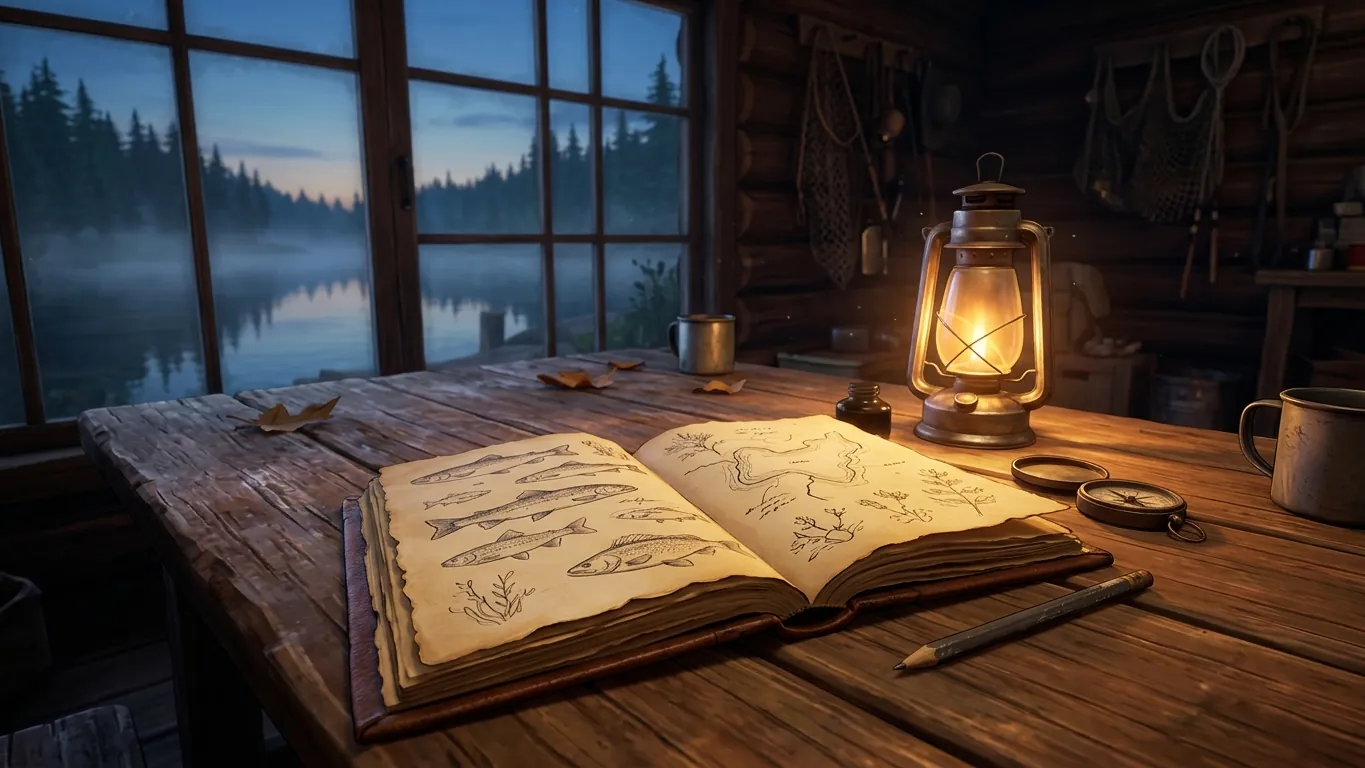
Memory is generous but unreliable. After a few sessions, the details blur together: which lure worked where, what the weather was doing, how long that quiet spell lasted. A journal keeps those details intact, so you can compare sessions honestly rather than relying on impressions.
The journal also changes how you play. Knowing you will write something afterwards makes you notice more during the session. You look at the conditions, think about your choices and pay attention to small events that might otherwise slip past.
This blog is written in the spirit of a fishing diary for exactly that reason. Writing things down is one of the most dependable ways to learn steadily.
There is no single correct format, but these five elements give most entries a useful backbone.
Note the body of water and the specific area you fished, such as a weedy inlet or a rocky point.
Record the in-game time of day, visible weather and anything notable about wind or light.
List your rod, line strength, hook size, lure or bait and drag setting, so results can be traced back to choices.
Write down bites, catches, losses and quiet spells, including roughly when they occurred.
End with something you want to test in the next session, so each entry leads naturally to the next.
A journal only helps if you keep it up, and long entries quickly become a chore. Aim for a few lines per session. Bullet-style notes are perfectly fine, as long as you can understand them later.
Honesty matters more than length. Record the sessions where nothing happened, the fish you lost through impatience and the experiments that did not work. These entries are often more instructive than the successful ones, because they reveal what to adjust.
It can also help to separate observations from interpretations. Write what you saw first, such as several bites near the reeds in the late afternoon, then add your guess about why, clearly marked as a guess.

Writing entries is half the value; reviewing them is the other half. Every few sessions, read back through your recent notes. Look for repeated patterns: a setup that keeps losing fish, a spot that stays active at a certain time, or a lure that rarely draws attention.
Treat patterns as ideas to test rather than conclusions. If your notes suggest one area is busier in the evening, plan a session specifically to check that. Either confirming or disproving it will deepen your understanding.
Reviewing also shows you how far you have come. Seeing early notes full of lost fish alongside later notes with steadier results can be quietly encouraging.
Over time, your journal becomes more than a list of sessions. It becomes a record of how you think about the game. Early entries may focus on simple questions such as which hook size to use. Later ones often explore subtler ideas about timing, conditions and presentation.
That shift is a sign of genuine progress, and it is something no scoreboard can capture. The journal reflects your attention and curiosity, not just your results.
Whether you keep it on paper, in a text file or in a spreadsheet, the habit is what counts. A few honest lines after each session can quietly reshape the way you play.
 One skill at a time: a gradual path on the water
A gradual path for improving in Canadian Fishing 4, from first casts to confident setups, focusing on one skill at a time and honest reflection.
Read more
 Small missteps on the water and how to adjust
A look at common habits that hold new players back in Canadian Fishing 4, from mismatched tackle to impatience, with calm ways to adjust.
Read more
 In praise of the unhurried cast
An opinion piece on why an unhurried, observant approach makes realistic virtual fishing in Canadian Fishing 4 more rewarding to play.
Read more